

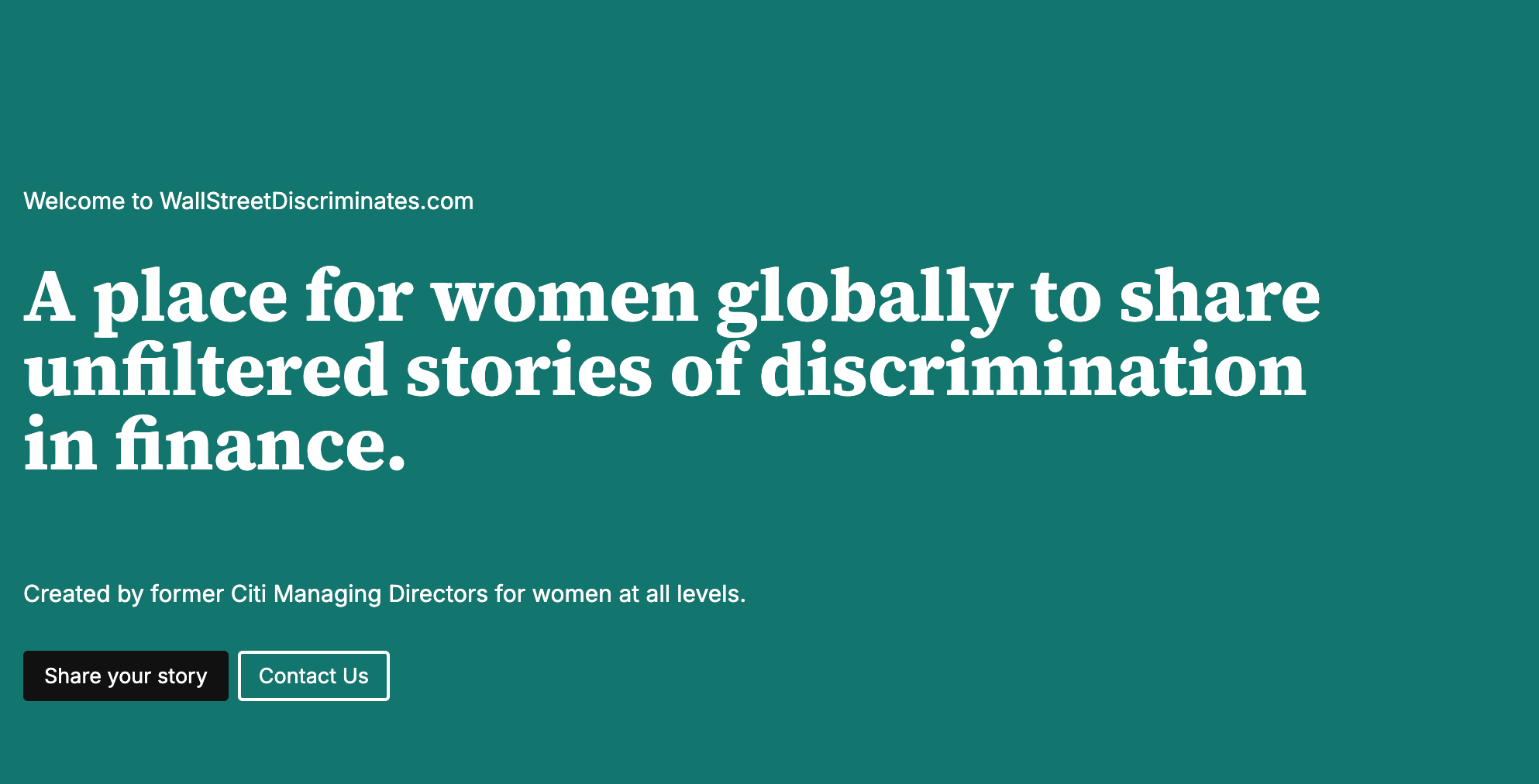
Recently I came across an initiative called Wall Street Discriminates, It is an anonymous platform created by a group of former Citigroup managing directors as a safe space for women in financial services to share unfiltered accounts of discrimination, harassment, and systemic bias. What began as a response to patterns of women leaving major firms has grown into an archive of personal experiences aimed at surfacing broader systemic patterns of workplace harm rather than isolated incidents. They cover stories from many different places, including the USA and the UK. They’re not limited only to finance, although that sector is heavily featured. It’s a powerful attempt to surface a new conversation, which is why I’ve decided to write about it.
The Habits of Harm
Honestly it’s more than depressing to read.
Collectively they tell a bigger story of organisational culture and how power works. Of how institutions keeps harm happening, stops people challenging it and keep power with the most powerful (men).
Before we dive into that, it feels important to take time to understand the insidious nature of the harm they speak of.
There are plenty of examples of harassment, bullying, overt racism, sexism, homophobia and ageism. But what feels more prevalent are the deliberate and intentional uses of institutional power to control, limit or remove women whilst preserving the organisation’s innocence.
Women and marginalised people describe being strategically undermined, their credibility chipped away, their options narrowed, and their exits engineered through systems that look neutral on the surface. Performance processes are used to rewrite reality. HR procedures are used to redirect blame. Complaints trigger scrutiny of the person who raised them rather than the harm itself. It’s next-level coordinated corporate gaslighting, and it’s happening in lots and lots of places.
‘HR is weaponised to squash anyone speaking up. They train us to speak up, contact Ethics or HR, and when you do, everything is used against you.’
What white supremacy culture helps us see
As someone who thinks a lot about organisational culture, I’m left with the question: what lessons should we learn from this, especially if we’re serious about integrity?
When I use the term white supremacy culture here, I’m not only talking about overt racial hostility. I’m naming a set of organisational habits and norms that prioritise control, comfort, and hierarchy over truth, equity and care. It’s a system of power, then is shaped by patriarchy, defended by capitalism and it constrains most of us, but especially those who are not at the centre of the power wheel. If you want to know more about this, you can go to Tema Okun’s website about this. These habits show up with remarkable consistency across the stories.
Defensiveness: the institution always comes first
A recurring pattern is how quickly organisations move into defensive mode when harm is named. The priority becomes managing exposure rather than understanding impact. The system searches for ways to neutralise the issue: minimising what happened, reframing intent, or questioning credibility. Defensiveness allows the organisation to remain stable, even if people are harmed in the process.
“The audacity to ignore facts, not addressing issues raised, labelling emails as just jokes, misunderstandings or mistakes, then the retaliation and the pressure to quit.”
Power hoarding: inclusion without power shift
Power hoarding isn’t just “decision-making is concentrated”. It’s the deliberate keeping of discretion in the hands of a few so outcomes can be engineered without accountability. It shows who gets to define performance, who controls hiring and restructuring, who decides what counts as evidence, and who uses phrases like ‘poor performance’, ‘poor fit’, or ‘it’s just business’, to remove people.
This is also how institutions can perform inclusion while keeping power exactly where it is. I’ve seen it, as I’m sure you have too - the language changes, the structure doesn’t. But this one contributor shares just how intentional that was in the place where she worked:
‘Their DEI strategy, underpinned by fake interviews, does not advance inclusion. It weaponises diversity for optics while maintaining entrenched privilege. The cost is borne disproportionately by Black, Brown, female, and LGBTQ candidates, who are exploited for appearances and left with lasting professional scars. Wells Fargo must be held to account for a system that prioritises quarterly profits and appearances over fairness and equity. Until then, marginalised people will continue to be denied genuine access to opportunity under the pretence of diversity.’
Worship of the written word: HR controls the paper trail
Another defining trait is the elevation of documentation over lived experience. What matters is what is written down, not what actually happened. But crucially, the institution controls what gets written, how it gets framed, and what becomes “evidence”. In these stories, HR often sits at the centre of that control.
“Over time, I watched HR shift from being a safeguard to becoming a translator, converting bias, fear, and power struggles into clean language and compliant processes.”
That translation is where legitimacy is produced. Harm is recoded into neutral categories and labelled with terms such as ‘communication’, ‘conflict’, ‘fit’, or ‘misalignment’. Once that translation is included in the documentation, it becomes authoritative and factual. Once something is documented in institutional language, it follows people, shaping future decisions. It can outweigh years of contribution or consistent evidence, because the written record is treated as the truth.
This is also how coordinated gaslighting can happen. The written word becomes a weapon, not a safeguard.
Right to comfort: whose comfort matters?
The ‘right to comfort’ is often described as people wanting to avoid awkward conversations. These stories show that comfort is also a form of power.
In many of these accounts, the organisation treats discomfort for leaders and high performers as an emergency, while treating harm to women and marginalised people as manageable. That is a hierarchy of care. The urgent things are the discomfort of being confronted, of reputational risk, of a complaint landing on someone senior. These become crises. Meanwhile, the person harmed is asked to be patient, reasonable, measured, and collaborative. This is where white supremacy culture, patriarchy, and capitalism overlap. Patriarchy demands that women stay easy to manage. White supremacy culture rewards calm control and punishes emotional truth. Capitalism backs whatever keeps the machine running.
The women behind these stories often paid a high price for speaking up, whether it was about their own treatment or on behalf of others. Inconvenient truth-telling or whistleblowing is seen as a risk to the system and is shut down and managed. There are no conditions in these organisations that support speaking up, and all cultural and leadership messages are to stay in your lane.
‘I demanded a chance to defend myself. Denied. My boss repeated the script: ‘The decision has been made. Call HR with any questions.’
Bravery is not a solution to systemic harm
There are many more examples of other traits laid out in these accounts, but for now I’ll stop there. What’s clear is that if the harm is institutional, solutions can’t rely on individuals being braver inside a system that punishes bravery, although there is some deeper personal work to be done to shift these norms being so readily accepted and reinforced.. The lever for lasting change is governance: reducing discretion, breaking retaliation pathways, increasing transparency and accountability mechanisms and making patterns visible and costly.
I’ll be following this initiative with interest, keen to see what it does next in taking this evidence of patterns and institutional harm into meaningful change in this sector.
The response below to the stories really moved me. What’s clear is that the solution isn’t only about men - there’s also women upholding and reinforcing these dynamics too, but it will need this kind of collective introspection to begin a journey of meaningful change.
“As a man my head hangs in shame when I read about these experiences of so many women across organisations, levels and geographies. What is it with us men that is forcing such behaviour? Do we achieve a sense of accomplishment by harassing the other gender or we have lost the sense of right and wrong?
This calls for deep introspection and course correction on our part. Both organisations and family set ups have an important role to play. If teach our kids from an early age to respect women at home a lot will be achieved. Organisations need to practice meritocracy and ‘old boys clubs’ need to be eliminated totally. Hopefully we can make the society a better place for everyone to coexist respectfully”.